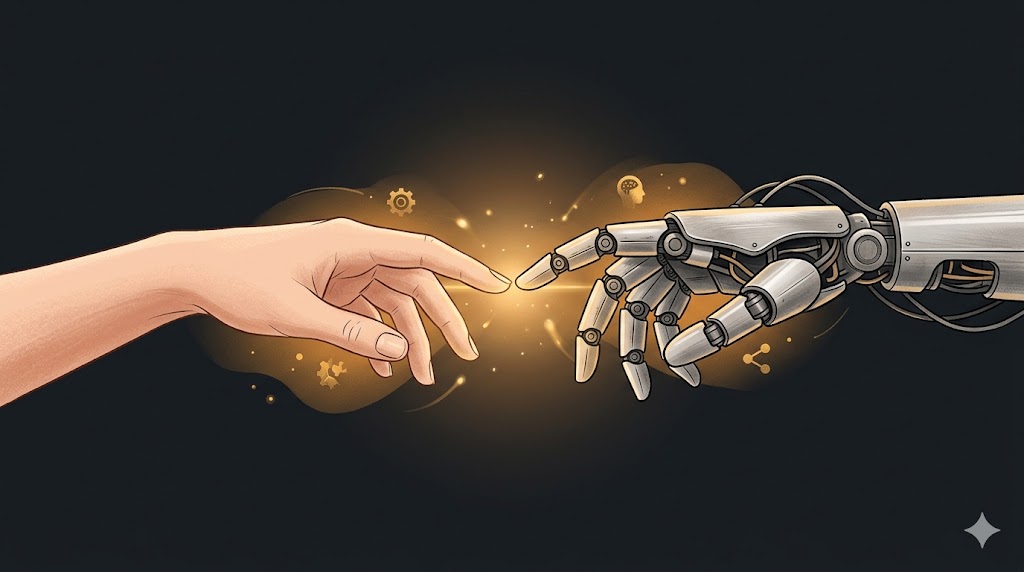
Everyone’s terrified or in denial. The truth is more nuanced — and more useful — than either camp admits.
It’s the question everyone’s asking but nobody wants to answer honestly. Tech optimists tell you AI will create more jobs than it destroys. Doomers say half the workforce is gone by 2030. Neither is particularly useful if you’re sitting at your desk wondering whether to update your LinkedIn.
So let’s cut through both camps.
The honest answer: it depends on what your job actually is
AI doesn’t replace jobs. It replaces tasks. And most jobs are a bundle of tasks — some of which AI is already very good at, and some it’s nowhere near capable of handling.
The question isn’t “will AI take my job?” The real question is: “what percentage of my job is tasks AI can do better and cheaper than me?”
If that percentage is high — and you’re not adapting — that’s a real risk. If it’s low, or if you’re learning to use AI to amplify what you do, you’re in a much stronger position than the headlines suggest.
Jobs at risk vs. jobs that grow
| Higher risk | Stronger position |
|---|---|
| →Data entry and basic processing roles →Repetitive content production (templated copy, basic reports) →Tier-1 customer support (scripted responses) →Basic code review and QA testing →Junior translation and transcription |
→Roles requiring judgment in ambiguous situations →Deep relationship management and trust-building →Creative direction (not just execution) →Cross-functional strategy and leadership →Anyone who knows how to use AI well |
The new skill that matters most
There’s one skill showing up consistently across every industry that’s adopting AI fast: the ability to direct AI effectively. Knowing what to ask, how to verify the output, when to trust it, and when to override it.
“The future isn’t about replacing humans. It’s about amplifying them.”
— Aparna Chennapragada, Chief Product Officer for AI, Microsoft
This is the “Human + Machine” equation that most headlines miss. A lawyer who uses AI to research case law 10x faster isn’t replaced — they’re more valuable. A marketer who uses AI agents to run 50 A/B tests simultaneously isn’t automated away — they’re a force multiplier.
What you can do right now
Practical starting points, no matter your field:
Map your tasks — which are repetitive?
Try AI on one of those tasks this week
Learn to write better prompts
Follow what’s happening in your specific industry
Build in public — share what you’re learning
The people who’ll struggle aren’t the ones in “at-risk” jobs. They’re the ones in any job who decide AI isn’t relevant to them. The ones who’ll thrive are those who get curious now, while the tools are still new and the bar to stand out is low.
The machine isn’t coming for you. But ignoring it might be.
